Monday, March 24, 2014

Alcoa Strategy Written by Shawn Stewart


For the past couple of weeks, I have been playing around with an income trading strategy with some of my bullish picks for the year. The company I used was Alcoa (AA). Since I was bullish, and I owned the underlying shares, I decided to sell puts (bets that the stock would go down) against my shares. For every 100 shares of a stock owned, you can write/sell an options contract for it. In this case, I owed 500 shares of AA, so I wrote 5 put contracts. Here’s the run down for the transaction:
  • On 2/21/2014, I sold to open 5 AA 11 Put contracts. The price per contract was $.15 (or 100 x .15= $15), and the shares were trading around $11.84. This means I received a $75 ($15 x 5 contracts) credit to my account.
  •  On 3/14/2014, I did a ‘buy to close’ transaction to buy the contracts back so I could close the position. On that day, AA was trading around $11.84, and contracts were trading for $.06 that day, so my profits were the initial $.15 premium minus the closing price $.06. That’s a $.09 (or $9) profit per contract.
  •  Take that $9 X 5 AA 11 put contracts, and my profit was $45

Even though the stock pretty much traded flat despite my bullish conviction, I was able to lock in a profit because the shares never dropped below $11. If I let the contracts expire worthless, I would’ve collected a total premium $75 on the trade instead of $45.

Though this strategy yields less return compared to some of the trades Britney has previously made, it was a comfortable transaction. Some traders want to make returns, and be able to sleep at night, and if that is your risk profile then, I would definitely suggest looking into this type of strategy.

Another upside to writing contracts on your shares is that there is potential on top of potential. First off, you would profit from any upside gain on the shares. Secondly, you will still collect dividends on your stocks. And lastly, you now have more income from collecting the premium!
Disclaimer: This was not a risk free investment. If Alcoa, dropped below $11 per share, I would’ve lost money. In this strategy, it is imperative to find 1) a strike price that has a bit of cushion given the time till expiration, and 2) finding the highest premium to write contracts for.
Thanks for reading.

Shawn

Sunday, March 23, 2014

Market Recap 3/21/14

This is the same recap I sent out via text on Friday.


Shawn will be posting an income strategy from his mock portfolio later on tonight. 


The big news this week was the FOMC meeting. The Fed decided to remove the 6.5% unemployment rate as a forward guidance target. Meaning the Fed will continue to keep interest rates low, which will encourage lending until the economy is stable. The removal of the 6.5% indicates that they are looking at more than just employment to gauge economic growth. 

Putin's comments eased some concerns of escalating tensions but commodities are still facing some volatility. 

There was some single stock news that put pressure on the major indexes but all and all, Friday ended light. 


Thanks for reading,

Brit

Sunday, March 16, 2014

Market Recap 3/14/14

Hello!

First off, I started sending quick market recaps via text to a couple of people interested in learning more about the market and staying up to date. If you're interested please comment below, find me on twitter @BritReport or email me at britreport@gmail.com
________________________________________________________________________

This week was full of macroeconomic news. I think it's important to understand how the events in the Ukraine  are impacting the U.S economy.


How we got here in less than 30 seconds:
  • Russia wanted to invade the Ukraine
  • The U.S does not want Russia to invade the Ukraine. To prevent the Russian invasion, the U.S threatened Russia with a number of sanctions. The sanctions will effect a number of businesses within the U.S.
  • Russia positioned troops for an invasion 
  • Today there was a vote on the decision to unite Russia and Crimea. The results were in favor of the union, however there are a number of questions regarding the validity of the results. 

It's good thing to remember  that geopolitical events effect a number of aspects in our economy, not just. Here are some of the effects:

Energy: Russia supplies Europe's natural gas, if we impose a sanction on Russia we could lose support from Europe. Without Europe, the sanctions will be less effective and Russian investors will pull their money out of the U.S and into Europe.

Currency: In times of uncertainty, investors want to decrease their exposure to risky currencies. On Friday, there was a rally in Japanese Yen. (the Japanese currency) Currencies are valued in comparison of another currency. As the Japanese Yen increased in value the US Dollar decreased in value. This indicates that the Yen was perceived as more stable than the dollar, which has a negative effect on the U.S.

VIX: Considered the "fear guage": was up 9.5%, indicating there is a lot of volatility surrounding the macro tape. As the uncertainity continues the market will continue facing downward pressure. 


In addition to the Ukraine, a slow down in China has also put pressure on the U.S Market.

The last week China released some poor economic data indicating a slow down in their economy. Considering that China has one of the largest economies in the world, a slowdown is definitely something that will be monitored closely going into next week. 

________________________________________________________________________


Trading has been tepid with lower then average trading volumes. I will be using this pullback to buy NASDAQ based techs. (TSLA, SCTY)
  • What do I mean by pullback? When the stock market is down it is a good time to buy stocks you like because they are trading lower. 


Thanks!

Brit


P.S 
If you would like to learn more about the Ukraine, I attached a map and a link to a timeline of Ukraines Political Crisis.


I read that American's were the most geographically challenged nation. So here's a map:


Sunday, March 9, 2014

3/7/14 Recap


Hello!


This is a just a brief overview of what happened in the markets Friday

  • Jobs numbers 
    • 175K jobs added in February beating the 140k estimates, a positive indicator considering the dismal January data and the extremely harsh weather conditions. 
  • Unemployment
    • The unemployment rate rose from 6.6% to 6.7%, the increase was caused by more people entering the workforce. 

These two pieces of data are extremely important as the market begins to prepare for tapering. If you need a tapering recap check out my "What the Fed" post.

With previous job releases, good data indicated that the tapering would end and cause the major indexes to go down. Conversely, missing expectations indicated tapering would continue and the markets would continue their record breaking rallies. That trend seems to be coming to and end as the market has slowly started correcting itself for the September taper. 

Check out this article for more details: U.S gains 175,000 jobs in February 

Going into next week...

Markets will be pretty cautious Monday as the bull market hits the 5 year mark. To put it in perspective the average bull market lasts about 4.5 years. Even though it sounds bad, the economy moves in cycles,so this is information will not catch investors by surprise. 


I don't have any positions on right now but as soon as I will post those.


Thanks,


Brit

Sunday, February 23, 2014

New Contributor - Shawn Stewart

Hello!

One of my goals for this year was to update the blog more frequently with market updates. As you may or may not know, I am also trying to graduate this semester! To ensure that the post become more regular I added a contributor to the blog.

Shawn is a junior finance major at the University of Missouri. He will be writing market updates as well as providing insight from his own portfolio. Just like myself, this is a learning experience for Shawn and it will give him the opportunity to look back and analyze his trades. I am excited to have another person writing!

Shawn and I will collaborate but that doesn't mean that we will always have the same opinion. We encourage you to share your ideas as we all expand our market knowledge.


Best,

Brit 


Tuesday, February 4, 2014

152 Feb14 DIA Puts


I was bearish on the market since last week because of the selloff in EM, mediocre earnings and the heightened sensitivity to economic data. 

I decided to maintain my short into Monday because of knee jerk reactions to economic news. One more data point could end up in a huge selloff, which is exactly what happened. 


How did I profit from a selloff?

Capture market sentiment
  • Because I was bearish, an index was the best way  to capture market sentiment instead of the sentiment of just one company
Pick an index
  • It was a choice between the S&P and Dow. 
    • I did not consider the NASDAQ because it includes a lot of tech companies that are not as negatively effected by the economic info releases.
  • I chose the Dow Jones because it seemed to be the most sensitive to the news surrounding the Fed and a the release of  manufacturing data
Pick a position
  • Purchasing puts indicates a bearish view
  • Most of my trades have been buying calls, this has "unlimited" gains because a stock price can technically  go as high as possible. Buying calls expresses a positive/bullish view
    • Puts are less intuitive than calls, I'll spare you the explanation for today 
Execute trade
  • This trade was executed with DIA options.  
    • DIA: An ETF; which is a security that tracks and provides similar performance to the Dow Jones
  • The trendlines indicated that the price would not fall below $150. I did not think it would go all the way to $150, so I picked a $152 strike. 
    • Delta ~ 30, which means I needed a decent size move for the position to see substantial price changes

Results
On Monday, bought 2 152 Feb14 DIA puts for $.96. Yesterday (2/3/14), sold both for 1.99. Realizing a $160.00 gain. 


What I learned:
  1. I should of bought more options, especially when the market rallied on Friday. This trade was extremely small. By adding to the position, the average price for the contracts would be lower making this trade more lucrative. 

Articles about Monday: 


Thanks,

Brit


ISM: The ISM non manufacturing index is a survey of purchases from non manufacturing companies. If the ISM index is increasing the stock market should increase because it perceived as an increase in the company's profitability.

Wednesday, January 29, 2014

What the Fed?


Our current monetary policy is not a topic that effects just investors. The Feds decisions effect EVERYONE and is something everyone should be familiar with.


The whole Quantitative Easing (QE) concept can be a hard pill to swallow especially if you’ve never heard of it before. The market is really sensitive to the Federal Reserve (The Fed) because their decisions are effecting investors forward guidance (views of the future)


QE  in 30 seconds:
  • Fed buys bonds and mortgage backed securities. The asset purchases cause lower interest rates, which encourages spending in the economy. Spending incentivize banks to lend, which increases financing activities for consumers and businesses.
  • The Fed was buying 85 billion dollars worth of assets each month and planned to continue until they felt the economy was somewhat stable. (lower unemployment, healthy market performance and growth)
  • QE= Fed training wheels for the American economy


Basically everyone is wondering when they are going to take off the training wheels, just like riding a bike if you are not ready to ride the two wheeler you could be in for a very rude awakening.

Instead of cutting the bond buying off cold turkey, The Fed is taking a screw out of one of the training wheels. Each month they are planning to reduce the amount of bond purchases by 10 billion per month, ending the monetary policy in 2014.  The move to decrease bond buying indicates that the economy is  getting closer to meet their standards.

The recent declines in U.S indices is due to the spillover from the selloff in Emerging Markets.
  • A selloff in emerging markets was caused by the central banks decision to tighten their monetary policy. Tightening means the Central Banks plan to increase interest rates, which would usually create an incentive for investors. The aggressive rate of tightening is concerning because it may hinder their economic growth, which is causing a selloff.
  • Detailed article about the EM Selloff: Emerging Markets Selloff Spreads from WSj


The market was pretty tepid going into the meeting. The Fed announced they will continue reducing the asset purchases. The downward momentum added to the index decline from EM. Despite yesterday's rally, I am maintaining a bearish view.


Here are some articles if you want some additional information about the Fed meeting:
Fed stays the course by tapering another $10 billion from MarketWatch
US stock indexes steeply lower after Fed does as expected from CNBC


Thanks,

Brit

Monday, January 27, 2014

SCTY 72.5 April Calls

Hello!

I decided to separate explanatory and position posts. This will make the information a little less overwhelming. Hopefully, the educational posts will build a foundation for the position posts.


The Story:

I was looking for a trade idea to start the year. Picking a position is a little overwhelming sometimes, there is a lot of data/ information to try and break down. I like to read SeekingAlpha and MarketWatch when I am looking for ideas.

I stumbled on this article: The Solar Outlook for 2014.

I chose SolarCity over the other companies listed because it was not as prominent as FirstSolar and there was more potential for a breakout move.

After picking SCTY, I used FINVIZ to look at the chart, focusing on technical indicators

  • SCTY was trading at $59.10, which was very close to the resistance level. Once a stock breaks the resistance level it will gain momentum causing a price jump

The Position: 

I wish I had the chart to show exactly what I was looking at but I don't :(

Anyways, the trendline indicated that if the resistance was broken the stock could rally to $70.
I picked an April expiration, a further expiration can cheapen the price of the option. After the expiration, I picked a strike price that was not too expensive but had a decent delta. 
  • Strike price: What you expect the price to be in the future
  • Delta: How much the options price is expected to change with the change in the actual stock
    • For example the delta was .50, therefore for every 1 point move in SCTY stock the option changed by .50
After all the research I decided on buying two 72.5 April Calls the next morning (Monday).

On Monday Goldman Sachs upgraded SCTY and the stock hit all time high's. Even though the price was way higher than when I initially decided on the trade, the trendline still had momentum to go even higher.

I bought 2 72.5 April calls at $6.85. 


The Profit:

SCTY continued to trade higher. On Jan. 16th my options were priced at $11.75! Almost double my purchase price!!!! I sold my calls and the trade realized a $960 profit.


Although I was bullish on SCTY, the rally seemed a bit overdone and I did not want to lose out on collecting profits. The next day it was trading at close to $80 but today it is at $69.


Here is the chart of the duration of my trade


Thanks for reading!!!

I realize there was not a lot of explanations in this post, hopefully as I write more of the explanation posts the material will be easier to grasp. 


follow me on Twitter: @TheBritReport


Thanks,

Brit

Market March Madness: 1/27/14

I am going to spend more time giving quick market updates, explanations and opinions. I will continue to post my positions but I want to give a little bit more information instead of giving information without laying the foundation.

Lets get into it.

There are 2 important topics going into this week: I'll explain 1 today and the other tomorrow

  1. Earnings
  2. The Fed Meeting ( I'm saving the explanation for Tuesday)
 
Earnings: The Market's March Madness

In light of Warren Buffet offering 1 BILLION dollars for the most accurate March Madness Bracket, I decided to use the tourney to loosely describe earnings. 


Regular Season: 
Earnings, which are released every quarter, draw a lot of attention because they indicate how profitable a company was during the previous quarter. Investor's pay close attention to earnings because they help paint a picture of  companies' current performance and the outlook for  the future. 

Think of it like this: Investors have been using various pieces of news throughout the quarter to gauge how the company is performing.  During the regular season you watch your teams the games and keep track of their record. The season record gives an idea of what can be expected going into the tournament. 


Filling out the Bracket:

Before earnings are released investors will start to take positions (buying or selling shares/options). Their positions reflect their opinion on earnings data.

  • Bullish : Buy into the stock before the earnings release in anticipation of a rally (large increase) and sell once it has hit the price you expected (collecting profits)
  • Bearish: Sell the stock in anticipation that the price will go down 
    • This is only profitable if your short selling, if the stock is in your portfolio, a sell would be to protect downside losses
Taking a position is similar to filling out your bracket. When filling out a bracket you consider  the teams record (previous earnings/info), the coach (CEO), industry (conference) and products/services (star players). Gathering all that info you are forecasting essentially who is going to lose and win. 


The Championship:

Okay fast forward through all the individual games and let's focus on the championship. For earnings, it is the same as their release.
 
The information people usually receive first is if the company beat or missed their earnings. Beating estimates (winning) and missing estimates (losing). The impact of the actual earnings will be reflected in how much the stock gains or loses. 

  • Beating estimates will usually cause the stock price to increase because it indicates that the companies had more revenue than anticipated.
  • Missing estimates will usually cause the stock price to decrease
Unlike winning and losing, the amount in which the stock moves in either direction is priced in by the reason the earnings were missed or beaten. Here are some examples of price reactions to earnings:
  • Company beats earnings because they fired a bunch of people, that is not considered a sustaining source of revenue growth, so the price decreases
  • Company missed earnings because they were hit with a one time legal settlement but has strong fundamentals, price decrease is not as big
    • JP Morgan (JPM) is considered a stable bank with the necessary tools to continue growth and maintain strength. A couple weeks ago, JPM missed estimates. JPM's miss was largely attributed to the number of legal settlements it faced during the quarter. This event is not something an investor would see as a fundamental issue, therefore the stock barely dropped.  

    • Company beats earnings because they saw a huge increase in advertising, which increased their profitability. This positive outlook will cause the price to go up. 
      • Microsoft's ad revenues increased by 34% which caused their stock price to increase 
    • Company misses earnings because they are terrible and have no sales and a very bleak outlook. Price goes down.
    These are just a few various way earnings can be digested.


    So to keep with the March Madness theme, say you expect earnings to beat estimates and you buy in early. The earnings are released and you were correct and the price soars. Just like picking the winning team in March Madness. Woohooo! 

     It isn't as black and white  as March Madness but hopefully I brought some clarity.

    Today all eyes are on Apple, which should be reporting earnings shortly.


    Best,

     
    Brit


    GLOSSARY
    Bearish: Expect prices to decrease, also known as being "short" 
    Bullish: Expect prices to increase, also known as being "long"
    Profit Margins: The proportion of sales that are kept for revenue, 20% profit margin means for every dollar in sales $.20 are kept for profits. (investopedia)
    Quarter: Three month time period, at the end of each quarter companies pay dividends and report earnings (investopedia)
    Revenue: The amount of money a company receives from sales, investments etc. (Investopedia)
     

    Sunday, December 22, 2013

    Under Construction until 1/12/14

    Hello!


    So I am working on revamping my blog for 2014. From the feedback here are some of the changes


    1. Market commentary in addition to my trading positions
    2. Increased number of posts (clearly need to work on that hah!)
    3. Shorter posts (not trying to bore you to death)  
    4. More interaction. If I explain something poorly, the post was too long/short, you want more updates, you want a specific news story explained. Please please let me know! I appreciate all feedback. 


    My next post will be on or before January 12th, 2014!

    See you next year!

    Brit


    P.S I will be posting a survey next week asking for feedback. I would greatly appreciate if you filled it out!


    Tuesday, September 24, 2013

    I'm back!

    Just wanted to give a quick update on my positions from last week.

    AAPL

    Man, I can't stay away from apple. It's a perfect play when I want to get in and out since the options are so liquid. People give apple such a hard time but I think it's a solid company... how many tech companies have the ability to issue 30 yr bonds? not many. I put this on after they announced their new software/set phones but before the release of the phone. This was an event driven move, as you can see from the quick turn around of positions. Bought 2 AAPL Oct 500 calls for 2.19 and sold them at 3.49 realizing a $221.96 profit. I chose October because the september expiration was right around the corner... as an option gets closer to its expiration the value diminishes (this is the theta value- one of the inputs of the black scholes model to price an option- #thingslearnedinNewYork) I'll go into all the greeks later this week.


    TSLA

    Okay shoot me, I hopped on the TSLA bandwagon. This was one of my first plays, I listened to this podcast on Bloomberg that talked about how Japan is requiring all producers of electric cars to pay to increase the number of charging stations. Hellllooo Tesla. Plus who can ignore a company with 400% returns in one year? Still bullish. Bought 1 TSLA Oct13 195 Call for $2.00 and sold them at $3.45 (notice the bought for/sold at- #thingslearnedinNewYork hahahah) 


    Right now I'm long the VIX it was up yesterday but it rebounded and erased some of my gains. I am also long UNG as test to my chart analysis techniques. This has been my struggle position but I'm keeping my view.

    As always, any questions: comment or tweet me. @TheBritReport

    Best,

    Brit

    Monday, August 5, 2013

    Fresh off the Street

    I'm baaaaa-ack.

    I just ended my internship in New York, which was awesome.

    Due to compliance I will not be trading for another 30 days.

    In the meantime if you have any questions about anything markets/intern related tweet me or comment!

    Best,
    Brit

    Wednesday, March 6, 2013

    Back from under the radar


    Heyy!

    I know I know, who knew this blog thing would be so hard to maintain! I look up and boom there goes 2 months lol. But here I am... with a lot of excitement

    I'm going to update my positions for the CME and QQQ. I'll tell you about facebook in the near future.

    CME Group Inc - WINNER!
    The CME has been the winner of the week! I had 2 strikes prices with a total of 5 Contracts but after today I still have the 2 strike prices but 2 contracts.

    On 2/12/13 I purchased 3 CME Jun13 60 Calls when the stock was at 57.09. CME is the Chicago Mercantile Exchange where a lot of commodity and financial instruments are traded.

    Why did I choose CME?
    One major component that stuck out about the CME is that they profit from every contract that goes through their exchange, regardless if the market is bullish or bearish. If the economy continues to pick up the CME will benefit from hedging. if  worries of the sequester come into play the CME benefits from liquidations of equities and the purchasing of fixed income. Last but not least the calls were extremely inexpensive.

    After the first purchase I added to position and on 2/19/13 I purchased 2 CMEJun13 62.5 Calls when the stock was trading at 58.95.

    On 2/27/13 I sold 2 CME Jun13 60 Calls trading at 59.78.
    This article confirmed my hypothesis and there was even more growth: CME Contract Volume up 7%
    Today (3/6/2013) I sold 1 CME Jun13 52.50 Call trading at 61.97.

    I sold them because I wanted to take some money in, increase buying power and realize a gain. If the price goes lower I can buy them cheaper, if they keep rallying I'll hang on to the 2 contracts I have. You wanna hope for the best but plan for the worst... the stock could always go back down. Through these trades I realized a $332.46 gain.


    QQQ Powershares Trust Series - loser

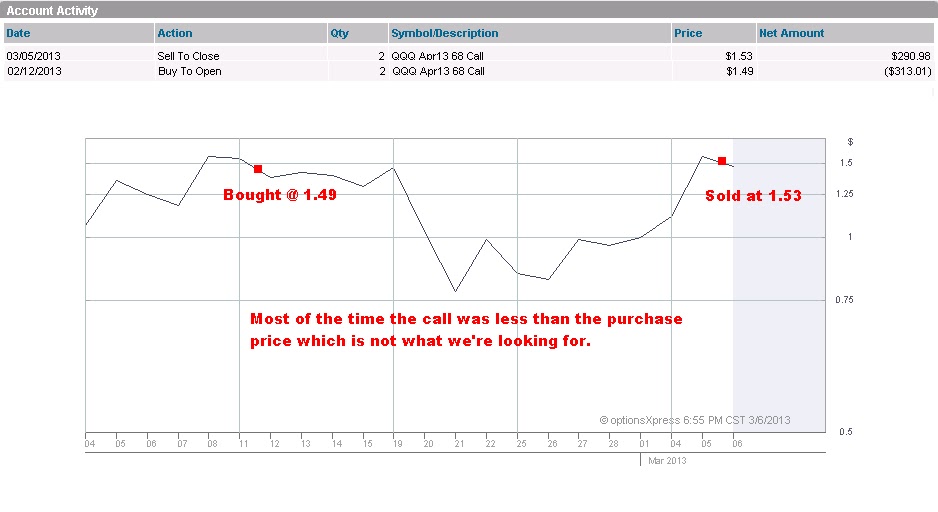
    On 2/12/2013 I purchased 2 QQQ Apr13 68 Calls trading at $67.95. QQQ Powershares are an ETF of the NASDAQ. I used an ETF because it gave me the ability to trade an index.
    • ETF- Exchange Traded Fund: A security that tracks an index, a commodity or a basket of assets like an index fund, but trades like a stock on an exchange. ETFs experience price changes throughout the day as they are bought and sold. ETF SOURCE
    • ETFs are also useful when getting your feet wet when it comes to commodities because like indexes the commodities are converted to ETFs to be traded like stocks.

    Why did I choose QQQ?
    There were two main factors that lead to the decision.
    1. Stocks in the NASDAQ are tech companies, I see a huge boom in tech because investors are looking for growth companies which are most common within the technology sector.
    2. A lot of non bulge bracket investors were keeping their money out of the market due to various political issues but Q1 earnings increased confidence to get back in the game and traditionally the first place they look is technology.

    So all signs were pointing to a jump in the NASDAQ, we saw the S & P and the DOW reach highs and figured it was their turn.

     On 3/5/13 I sold 2 QQQ Apr13 68 Calls trading at 68.57

    I attached a graph/table to show the beginning and end of the QQQ, the price was in the red for a majority of the time. It was up 4 cents yesterday and I decided to sell it. I like the index but I wanted to liquidate to lay off some risk, Apple's weakness is making it tough for QQQ to rally, especially by my expiration. After it was all said and done I lost about $22.03, which was mostly commission but you have to pay to play =)


     That's all for now!

    Also as a side note. For the more seasoned market aware folks reading, I won't be posting a lot of spreads/technical analysis on my blog. A lot of the technical mumbo jumbo confuses the everyday curious reader. Plus I can't give away all my secrets =)

    Best,

    Brit

    I forgot! follow my twitter for up to date info or to ask me questions! I enjoy questions!

    @TheBritReport

    Saturday, January 5, 2013

    Happy New Year!

    Hello!

    I know I have been so MIA this past month but between finals and the holidays I took a little break. I will begin updating both my blog and twitter more frequently.

    Today I will be updating on some market trends.
    In the next week or so I will update you with my positions.


    I am so glad that Fiscal Cliff is all figured out. In the midst of the new agreement the Fed indicated that they were going to slow down their efforts to stimulate the economy. This sent most broad  indexes in the red for the day.

    What do I mean by "slowing down efforts to stimulate the economy"?
    When the Fed decides to stop stimulating (injecting more money into the economy by buying bonds) that usually means that consumers and business are only left to each other to buy and sell on the market and a lot of people fear that we are not stable to produce growth.
    This information effects the market in more ways than one.
    1. Effects economic growth sensitive equities (for example technology)
    2. Effects commodities

    Commodities: Commodities are gold, crude oil, soybeans, corn and various raw materials.

    Why are they effected by the news?
    Slowing down the stimulus -> slowing down the economy -> slowing down the use/need of  oil

    In one of my previous blogs I mentioned how crude oil will show trends in the market. When there is an idea of the economy slowing down the prices for crude oil are going to drop because there will be less demand (people are pinching their pennies)

    But there is in fact a light at the end of the tunnel.

    Despite ending in the red zone on Thursday stocks ended higher on Friday.

    What happened in those 24 hours?

    Unemployment numbers! 155,000 jobs were added and unemployment met most predictions at 7.8%

    How do unemployment numbers effect the market?

    • When they are lower than predicted that usually means you will see some red at the end of the day, less jobs were added-> less people making money-> slow economy 
    • Expectations are met indexes will be in the green. There were the jobs we expected-> expected level of consumers-> expected economy
    • Expectations exceed predictions indexes and crude will end in the green. There were MORE jobs-> MORE consumers-> better economy. woohoo! 
    Crude oil closed at .2% while Gold closed at -1.5% 
    The S & P was the standout index ending with a 5 year high! 
    Financial stocks led while tech weren't so lucky.

    When looking at different stocks they effect different indexes. Since tech stocks slowed that will effect the NASDAQ which includes mostly tech stocks.


    Funny how different two days can be! 

    To buy: looking at Google (as always) I know I seem partial but we see good performance from Google however Google is looking a little rich (as in expensive) at these levels, I'll be looking to buy on a pullback (when there is a price drop). Also apple and BP. I'll let you know of any buys!

    Let me know if you have any questions!

    Brit


    Sunday, November 25, 2012

    November 25th: Where do I start?

    Hello Everyone!

    Long time no see, I have something special in the works for you guys so please be patient with me :)

    I conducted a workshop over the weekend and I got a lot of questions and I wanted to offer answers to whoever is reading! The number one question I received is where do I start?
    Here are some of the steps I took. As you know if you have any questions tweet me, comment etc!


    1. First make the decision that you want to begin trading. Although this seems like a no-brainer, trading does involve commitment and risks. If you're willing to put in the time you can really learn a lot and do more with your money. Remember a lot of the market is based on people's emotions. As soon as you put a trade into play check your emotions at the door, the market is going to do what it wants. Trade accordingly.
    2. Set a trading plan.This is SUPER important. Don't fudge your plan to fit what you want to do. When you've hit your desired profit liquidate. If you've been losing on a position, get out. It's important to set these standards beforehand so you are not trying to figure it at the last minute.
    3. Decide how much money you are willing to invest. This should involve a serious look into your finances. This money should come out of discretionary income, not rent/bill/emergency money. There is an opportunity to make money but there is also an opportunity to lose that money as well.
    4. Now that you've put some money aside set your targets.This goes for both losing and winning positions.
      • What are you willing to risk? Set your risk level at a safe percentage (1%-5%). Meaning if you have $1,000 position and it's down $150 get out and stay out.
      • What is your target profit (risk/reward)? How much are you willing to risk in order to make a profit. If you're just going to break even from a trade then what is the point of even doing it? AT LEAST have a 2 to 1 ratio (for every 1 dollar you risk, there is a 2 dollar reward) 
    5. Exit and entry strategies.
      • Now that your risk level is set be ready to exit a position if it is not performing. You will not always pick a perfect stock and you will be wrong. Don't wishfully think some magic is going to happen. Get out! Write down where you want to get out, discipline yourself to get out. This also goes for profitable positions, once you've hit your mark liquidate. You will never lose taking a profit. It is a horrible feeling when a position is losing because you held on too long. Don't be greedy!
    6. Compare online brokerage accounts. If you are going to trade options which is what I mostly talk about in my blog I would suggest Options Xpress, they have pretty good rates. Beyond rates look at their virtual trading system, tutorials for entering positions and options for your mobile device. I haven't looked around recently perhaps I will do a comparison one of these days. 
    7. RESEARCH RESEARCH RESEARCH. Watch the news find out what is going on in the world, what is going on in the economy.
    8. Pick some stocks that you think are going to grow. I think this is where a lot of people get overwhelmed. The thing that I like about options is that you do not have to pay the price of the stock, which gives you access to companies like Apple and Google. You're deciding on a movement, which makes it a more manageable. PAPER TRADE (or Virtual trade in most cases) Act like your actually trading without using your money. You are the consumer,companies base their success on your purchasing decisions.
    Don't be overwhelmed! Be discpilined, have confidence and gain knowledge.

    I know this was a wordy post but I got a lot of questions on where/how to start so I wanted to give some details.

    Thanks!
    Brit


    I have attached some pictures from my workshop last week!


    Thursday, October 25, 2012

    October 24th, 2012

    Hello!

    I have some tips after looking at the market so far this week.

    The DOW and S & P have been trending downwards the last couple of days and if you're looking to buy now is the time! Right now the market has been pretty dull, there have been some earning winners but the rumors of Bernake retiring (which would slow down the market)  and Romney's performance on Monday (chances of having a businessman in office) have some investors worried.

    What do you do when the markets are flat? Don't get scared or shrug away, BUY!!

    One of the fundamentals of trading: Buy low, sell high. You aren't going to be able to buy as much in bullish market.


    I've attached the charts for both below to show trends


    Buy some gold! The Gold December options (GCZ2) are a buy right now!
    When people start to get worried about the stock market they look to gold.

    I've attached a chart showing the relationship between the Dow and Gold for the last 3 years.  We notice that when the dow drops gold goes up. What's the dow doing right now...(Going Down) it's just a matter of time before gold reacts.


    The price forecast of gold for 2013 has been estimated $2,000 per ounce!


    Google: Google is a good company and we've seen solid growth in the last six months. Right now is the time to take advantage of the price drop (anywhere between 675-680). I'm going with some $755 Nov Calls (priced at about .65). Google was able to reach the 750 range at this beginning of this month/ end of September and I think we will see it again.


    I'll tweet more buys if I have some.

    Let me know if you have any questions or if you have some potential buys.

    Saturday, October 13, 2012

    October 13

    I am so sorry! I have been swamped with midterms. But I wanted to give informative post that kind of breaks down the options market.

    What is an option?

    An option is a derivative instrument based on stocks, commodities, futures etc.

    you're probably thinking... What is a derivative instrument?  It is a trading tool that is valued from another security. This means the value of the option moves due to other securities and variables.
     ( from http://www.optiontradingpedia.com/)

    Options Quotes

    Unlike the stocks you see ticking on the top of your iphone a options price will be listed separately. While the stock price is important factor of an option it is possible for an option to be down while it's stock is up. I have attached a picture of an options chart 
    (from Yahoo Finance Options for Google)


    I have previously tweeted things like I bought a Sept 115 Goldman call, this mean that from the time I bought the call until it expires I expect the stock to be $115. I bought the option when it was trading around $99. We see here how the stock price plays a roll in the option but isn't the end all be all to the option. 

    Research and expiration

    Options are speculative, you speculate if the stock will go up or down. It isn't very smart to just go make decisions on stocks without doing the proper research. You can use sites such as marketwatch and cnbc to identify trends, use current events such as earnings. You can also use spreads but that is a little advanced. Make sure you use the information to help gain an edge.

    When picking the price of the call you want the option to be "in the money" before it expires. For instance it is possible for Google to trade at $1000.00, but if you're buying an option that expires soon it is very unlikely for it to happen in the given time frame.

    With that being said it's important to pay attention to the price you pay or the price you sell the option (bid/ask) the closer you get to being "in the money" the more expensive they will be. If we look at the table from earlier we see that as the strike price increases the price decreases. 

    Benefits of Options

    Options give you the opportunity to trade highly priced stocks without the capital. (yay for college students) for example: You buy 100 Oct. GOOG Calls, that will cost $300. If you wanted to buy 100 shares of GOOG it would cost $74,400 (woah).
    When picking your calls or puts don't just go by the cheapest price, pay attention to the strike and the expiration.

    Options also offer some protection, you can only lose the amount that you paid. If we look at the previous example, if GOOG starts to move against you, the loss will be $300 as opposed to $74,400.

    They also offer flexibility, you can gain on an option that is gaining or losing. You can also be conservative or risky.


    Let me know if you have any questions! I am here to help. I know it's a lot of information but it's important to understand the basics before you start!

    Best,Brit

    For up to date info follow my twitter


    Sunday, September 9, 2012

    September 9th, 2012

    GOLDMAN!

    So I haven't had many positions since my last update. I picked up some last minute calls of $GS and just waited and watched! It moved slow but I am so glad I was patient.

    I had about 40 $115 September Calls, it was finally "in the money" on Wednesday as it got closer and closer to the 115 price. By Friday this was about a $5,000 trade. Happy Birthday to me!

    I've been researching all weekend for some new positions. Check my twitter for my most up to date trades. www.twitter.com/TheBritReport

    Thanks!
    Brit

    Saturday, August 25, 2012

    August 25th, 2012

    Hello!

    I'm back! I finished my internship about two weeks ago so I've been spending the last couple of weeks preparing for school. Since my last post I've made a few trades. I will be getting back into the swing of things on monday.

    Google
    On top of Goldman I dipped back into Google buying a September $705 call for 1.85 selling it at $3.60 realizing a $365 gain.

    Goldman
    I'm still heavy in Goldman. I've bought about 10 more 115 September calls looking to see some upward movement this week. The stock has climbed since my original buy but still not enough.


    Got excess refund?

    Earlier this week I tweeted about investing your refund check. I'm not financial planner but I will share that right now interest rates are low. You will barely get any money back placing excess funds into CD or savings account. I would consider an options account. Read up on stocks you like, practice paper/virtual trading and if you have questions tweet me! Options accounts usually just charge a commission and it's a better than just letting your money sit.

    Be sure to follow me on twitter for my most up to date trade info @TheBritReport

    Friday, August 10, 2012

    August 10th, 2012

    Hello all!

    Let's get to the money!

    Ten Year Note

    FINALLY the TYU turned in my favor. I had 6 short positions since about the end of July for September expiration. I had an average of 134'410 and liquidated at 133'175.

    Here's are the calculation for profit for a short position

    Sold Price     Bought      Tics      Tic Value     Profit
    134'000     -  133'175 =   17.5  x      31.25    = $546.875
    133'270     -  133'175 =   9.5    x      31.25    = $296.875
    134'110     -  133'175 =   25.5  x      31.25    = $796.875
    135'025     -  133'175 =   49     x      31.25    = $1531.25 * 3 = $4593.75
    __________________________________________________________________
    Gross Profit                                                                              $6,234.375

    AWESOME!
    At one point this looked like a loser but I held out and didn't let my emotions take over and now it's $6,200 winner. If you've been following my TYU calls... you're welcome =)
    Goldman Sachs

    Currently, I have 25 Goldman Sachs (GS) 115 September Calls. I have been extremely bullish. As I stated on twitter a couple weeks ago it only takes some good news to have it shoot up. I am hoping that the news about Goldman not having legal liabilites regarding the subprime mortgages gives the stock a boost today. I need a rally in GS NOW.


    That's all for now!

    Brit